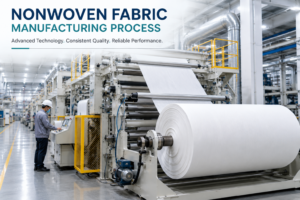
Nonwoven fabric is made directly from fibers rather than from yarn. Manufacturers bond, fuse, or entangle fibers together using heat, chemicals, mechanical action, or solvents, skipping the weaving and knitting steps that ordinary fabric requires. This single fact is the reason nonwoven production can turn raw fiber into finished roll goods in one continuous line, often within seconds rather than the hours a woven fabric needs.
What Makes Nonwoven Fabric Different From Woven Fabric
A woven fabric interlaces two sets of yarn at right angles. A knitted fabric loops a single yarn into interconnected stitches. A nonwoven fabric skips yarn entirely. Fibers, either short staple fibers or continuous filaments, are laid into a loose sheet called a web, and that web is then locked together by heat, mechanical entanglement, or chemical binder.
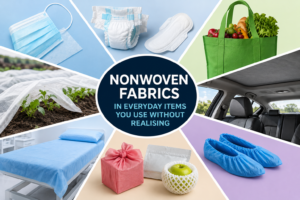
This distinction matters because it explains nonwoven fabric’s core trade-off: production speed and cost are far lower than weaving or knitting, but the fabric usually has directional strength instead of the balanced strength you get from an interlaced structure. That is why most nonwoven fabric is designed for single-use or limited-use products such as wipes, masks, and hygiene materials, rather than for garments meant to be worn and washed for years.
The Four Stages of Nonwoven Fabric Manufacturing
Every nonwoven production line, regardless of the specific technology used, moves through the same four stages. A reliable Non-Woven Fabric Manufacturer ensures each stage is carefully controlled to maintain consistent quality, performance, and durability throughout the production process.
- Fiber selection and preparation: raw fiber or polymer is chosen, opened, and blended
- Web formation: loose fibers are arranged into a continuous sheet
- Web bonding: the sheet is consolidated into a coherent fabric
- Finishing and converting: the fabric is treated for specific properties, then cut and shaped into a final product
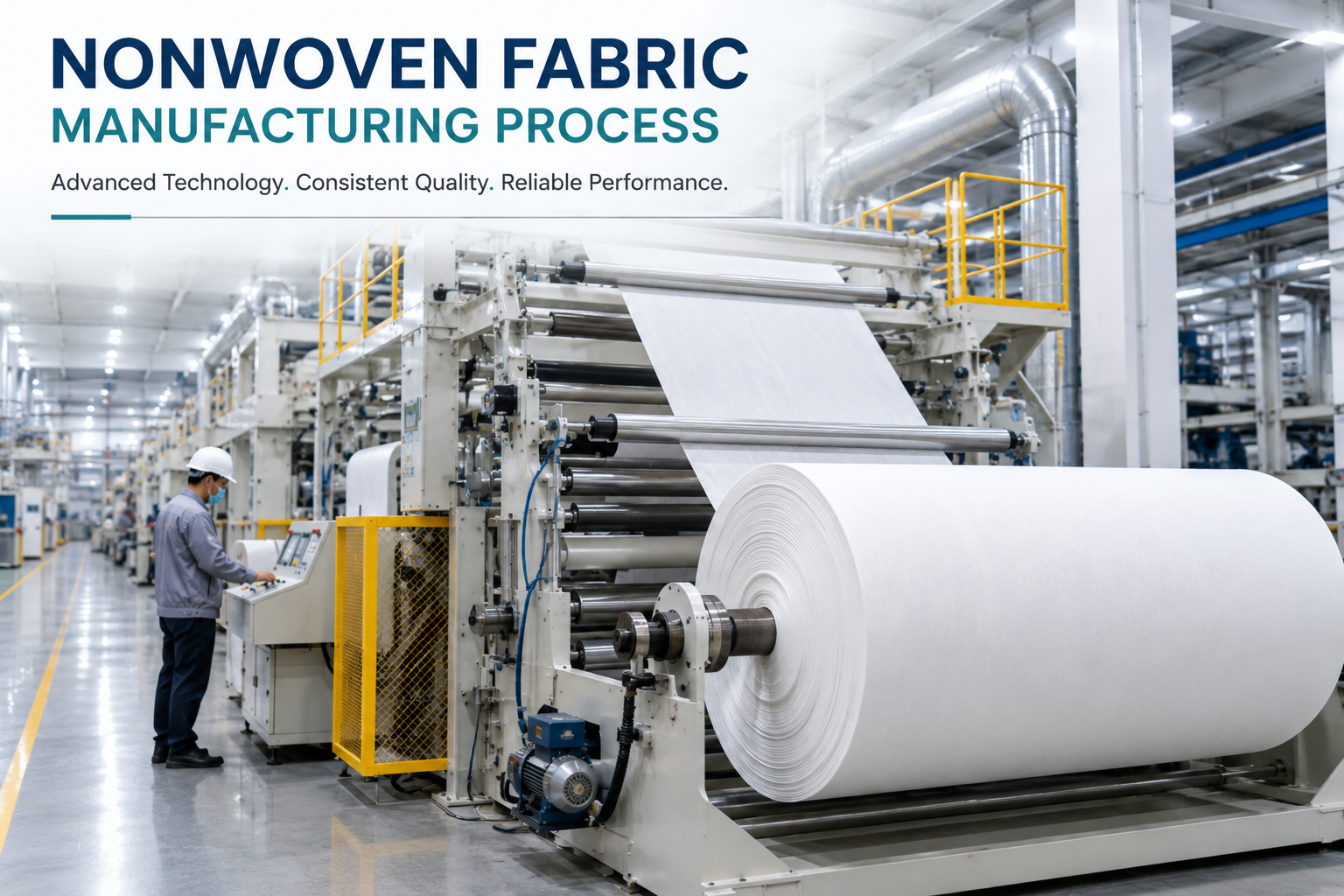
Modern lines often overlap these stages. A spunbond line, for example, forms the web and bonds it in the same continuous pass, with no intermediate roll of unbonded web ever produced.
Stage 1: Fiber Selection and Preparation
Fiber choice determines nearly every downstream property of the finished fabric, including softness, strength, absorbency, and cost.
Manufacturers typically start from one of three raw material categories:
| Raw Material Category | Common Examples | Contributes |
| Synthetic polymer | Polypropylene, polyester, polyethylene, nylon | Strength, chemical resistance, low cost, moldability |
| Natural fiber | Cotton, wool, jute | Absorbency, breathability, biodegradability |
| Regenerated or recycled fiber | Viscose, Tencel, recycled polyester | Sustainability, softness, reduced virgin material use |
Fiber fineness, measured as denier or micron, is a critical and often overlooked variable. A finer fiber (lower denier) produces a softer, more drapable fabric with a larger surface area for filtration, while a coarser fiber produces a stiffer, more abrasion-resistant fabric at lower material cost. Meltblown fibers, for instance, run in the 1 to 5 micron range specifically because ultrafine diameter is what gives the fabric its filtration capability.
Before web formation begins, baled fiber is opened and blended in an opening line to remove clumps and impurities and to produce a homogeneous mix. This step directly controls the uniformity, and therefore the quality, of the finished web. Uneven opening at this stage cannot be corrected later in the process.
Stage 2: Web Formation Methods
Web formation is where the loose fiber sheet is created. The method chosen depends on whether the manufacturer starts from staple fiber, filament, or polymer melt.
Drylaid (Carded) Web Formation
Baled staple fiber is opened, blended, and fed by air transport into a carding machine, a rotating drum covered in fine wire teeth that combs the fiber into a thin, continuous web. The fibers can be laid parallel to the machine direction, which produces high strength along that direction but low strength across it, or randomized through cross-lapping, which produces more balanced strength in both directions. Carded webs are typically made from staple fiber between 20 and 150 millimeters long.
Airlaid Web Formation
Short fibers, frequently wood pulp, are separated into individual fibers and carried by an air stream onto a moving screen, where they collect into a web. Airlaid webs are notably absorbent and bulky for their weight, which is why the process dominates feminine hygiene and tabletop wipe production.
Wetlaid Web Formation
Fibers are dispersed in water to form a dilute slurry, similar to conventional papermaking, and then deposited onto a moving mesh where the water drains away and the fibers settle into a web. This method handles very short fibers and fiber blends that other methods cannot process, which is why it remains the standard for tea bag paper and surgical gauze.
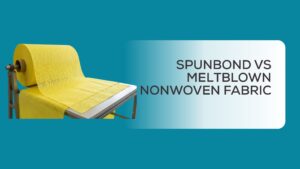
Spunlaid (Spunbond) Web Formation
Molten polymer is extruded through a spinneret to form continuous filaments, which are stretched, cooled, and deposited directly onto a moving belt. Because the fibers are continuous rather than cut to length, spunbond fabric gains significantly more tensile strength than carded webs for the same weight of material.
Meltblown Web Formation
Molten polymer is extruded through a die containing hundreds of small orifices, and high-velocity hot air attenuates the polymer streams into extremely fine fibers, typically 1 to 5 micrometers, before they land on a collector screen. The fine fiber diameter creates a web with a very high number of small pores per unit area, which is the physical basis of its filtration performance.
Submicron Spinning
An emerging refinement of meltblown and electrospinning technology, submicron spinning produces fibers below one micron in diameter. It is used where filtration efficiency requirements exceed what standard meltblown fiber can achieve, such as in high-grade respirator media.
Stage 3: Web Bonding Methods
A freshly formed web has almost no strength. Fibers are only held together by light friction until they are bonded through one of three mechanisms.
Mechanical Bonding
Needle punching drives barbed needles repeatedly through the web, physically dragging fibers from one layer into the next and locking them together through entanglement. Needle density typically ranges from 50 to over 1,000 punches per square centimeter depending on the target strength and thickness, and this method works with almost any fiber type except very fine deniers, which the needles tend to break.
Hydroentanglement, also called spunlacing, replaces needles with fine high-pressure water jets, commonly operating between 50 and 400 bar, that force fibers to interlace with each other. Because there is no chemical binder and no melted fiber, hydroentangled fabric retains a soft, cloth-like drape, which is why it is the standard bonding method for facial wipes and surgical drapes.
Thermal Bonding
Thermal bonding melts a portion of the fibers in the web, either by passing the web between heated calender rollers with an embossed pattern (thermal point bonding) or by forcing hot air through the entire web thickness (through-air bonding). Bonding temperatures typically fall between 120 and 180 degrees Celsius for common polypropylene and polyester blends. Point bonding produces a lighter, more breathable fabric with visible bond points, while through-air bonding produces a bulkier, softer, higher-loft fabric, which is why through-air bonding dominates diaper topsheet and absorbent core applications.
Chemical Bonding
A liquid or foam binder, commonly an acrylic or vinyl acetate resin, is applied to the web by spraying, printing, or saturation, and then cured with heat. Chemical bonding allows precise control over strength, stiffness, and hand feel independent of the fiber type used, but it adds cost and can affect breathability and the fabric’s environmental profile compared to thermal or mechanical bonding.
Stage 4: Finishing and Converting
Finishing treatments modify the bonded fabric’s surface or bulk properties without changing its basic structure. Mechanical finishing includes stretching, perforating, and crimping to adjust texture and bulk. Chemical finishing adds functional coatings that make the fabric flame retardant, antistatic, water repellent, or antimicrobial. Surface treatments such as calendering, printing, or lamination to a film or another fabric layer round out the property profile for the intended end use.
Converting is the final step that turns a roll of finished nonwoven fabric into an actual product. This includes slitting to width, die cutting to shape, folding, pleating, ultrasonic welding, and sewing. Many finished consumer products, from surgical masks to diaper components, require several converting operations layered on top of each other before the product is ready to ship.
Comparison of Nonwoven Manufacturing Methods
| Method | Typical Fiber | Bonding Basis | Typical Weight Range (GSM) | Relative Strength | Relative Cost | Best Suited For |
| Spunbond | Continuous filament | Thermal, self-bonded | 10 to 200 | High | Low to moderate | Diaper backsheet, geotextiles, bags |
| Meltblown | Continuous microfiber | Self-bonded | 10 to 60 | Low | Moderate | Mask filter layers, oil absorbents |
| Spunlace (hydroentangled) | Staple or filament | Mechanical (water jet) | 30 to 100 | Moderate | Moderate to high | Wipes, medical drapes, gauze |
| Needle punched | Staple fiber | Mechanical (needle) | 100 to 1000+ | High (thickness-dependent) | Low to moderate | Geotextiles, felts, automotive |
| Thermal bonded (carded) | Staple fiber | Heat fusion | 15 to 100 | Moderate | Low | Diaper topsheet, disposable garments |
| Airlaid | Pulp or short staple | Thermal or chemical | 30 to 200 | Low to moderate | Moderate | Feminine hygiene, tabletop wipes |
| Wetlaid | Very short fiber blends | Chemical or mechanical | 10 to 60 | Low | Moderate to high | Tea bags, filter paper, gauze |
How Manufacturers Choose a Production Method
The decision rarely comes down to a single factor. In practice, manufacturers weigh four variables against each other.
Fiber compatibility rules out options first. Very fine deniers cannot be needle punched without fiber breakage, and very short pulp fibers cannot be spunbond because there is no continuous filament to extrude.
Target properties narrow the field further. A product that needs softness and drape, such as a wipe, points toward hydroentanglement. A product that needs filtration efficiency, such as a mask layer, points toward meltblown regardless of cost.
Production economics matter because spunbond and thermal bonding run at the highest line speeds and lowest cost per kilogram, which is why they dominate high-volume commodity products, while wetlaid and hydroentanglement carry higher capital and operating costs and are reserved for products where those costs are justified by performance.
Regulatory and end-use requirements, particularly in medical and filtration markets, can mandate a specific bonding method or fiber combination to meet a filtration efficiency or fluid barrier standard, which removes cost as the deciding factor entirely.
Quality Standards and Testing
Nonwoven fabric quality is governed by both industry association guidance and formal test standards. In Europe, EDANA (the European Disposables and Nonwovens Association) publishes classification and test methods for nonwoven materials. In North America, INDA (the Association of the Nonwoven Fabrics Industry) fulfills a similar role. ASTM International maintains specific test standards for properties such as tensile strength, basis weight, and pore size, which manufacturers reference when specifying fabric for medical, filtration, and industrial applications. For products such as N95 respirators and surgical masks, filtration efficiency and fluid resistance are tested against specific regulatory thresholds rather than general nonwoven industry guidance alone.
Applications by Manufacturing Method
- Spunbond: diaper backsheets, shopping bags, geotextiles, agricultural crop covers
- Meltblown: N95 and surgical mask filter layers, oil and chemical absorbents, liquid filtration media
- Hydroentangled (spunlace): facial wipes, baby wipes, surgical gowns and drapes, cosmetic sheet masks
- Needle punched: automotive interior felts, carpet backing, road and railway geotextiles, insulation
- Thermal bonded: diaper and feminine hygiene topsheets, disposable protective garments
- Airlaid: feminine hygiene cores, adult incontinence products, tabletop wipes
- Wetlaid: tea bags, surgical gauze, specialty filter paper
Need Nonwoven Fabric Manufactured to Your Specification?
We manufacture nonwoven fabric across spunbond, meltblown, and hydroentangled processes, tailored to your GSM, strength, and application requirements. Share your specifications and get a quote from our team. Get a Quote
FAQ
How is nonwoven fabric made without weaving or knitting?
Nonwoven fabric is made by arranging fibers into a loose web using air, water, or mechanical carding, then locking that web together with heat, mechanical entanglement, or chemical binder. No yarn is spun and no interlacing or looping step is involved at any point.
What is the difference between spunbond and meltblown nonwoven fabric?
Spunbond fabric is made from continuous filaments stretched into strong fibers, giving it high tensile strength. Meltblown fabric is made from the same polymer melt but attenuated into far finer microfibers by hot air, giving it superior filtration but low strength. They are often layered together as SMS fabric to combine both properties.
Why is meltblown fabric used in medical masks?
Meltblown fabric’s fiber diameter, typically 1 to 5 microns, creates a dense network of small pores that captures airborne particles effectively while remaining breathable. This filtration performance, not cost or strength, is why it forms the middle layer in surgical and N95 masks.
Can nonwoven fabric be recycled or is it always single-use?
Nonwoven fabric can be engineered for either outcome. Many nonwoven products, including geotextiles and automotive felts, are built for years of service, and single-polymer nonwoven fabric such as pure polypropylene spunbond can be mechanically recycled, though chemically bonded or multi-material laminates are harder to recycle.