Have you ever picked up a sewing pattern that mentions “interfacing” as a material? If so, then you have likely asked yourself what role it plays. The role of interfacing is simple; it serves as an under layer of fabric that helps add some stiffness to various parts of clothing, ensuring the structure and shape of collars, waistbands and so on remain intact.
The most popular kinds of interfacing are woven and non woven interfacing, which might be hard to distinguish from each other because they look alike on the roll yet work entirely differently when used. So how do woven and non woven interfacing differ? We will tell you all about that and more in this article.
In this guide, we’ll break down what each type is, compare their structure and performance side by side, and help you decide which one fits your next project.
What Is Interfacing?
Interfacing is a supporting fabric layer attached to the wrong side of a piece of clothing for added structure and stability. It does not show but serves only an internal structural purpose of stabilizing those areas which require structure under strain or use.
What is interfacing in sewing? It is normally used on collar, cuffs, waistband, placket, bag panels and wherever there is a need for a stiffener that the fabric lacks. There are different types of interfacing and this is where the choice of woven or non-woven comes into play.
What Is Woven Interfacing?
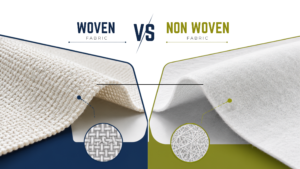
Woven interfacing is produced in the same way as the normal fabric with threads going in two different directions (lengthwise and crosswise), thus having grain, just as your fashion fabric does. As a result, it has to be cut on the grain as your garment piece, similarly to any other woven fabric.
The grain makes this kind of interfacing fabric more like your fashion fabric in terms of drape and movement. This makes it especially suitable for tailoring of coats, collars, cuffs, etc. Woven interfacing can be both iron-on and sew-in; it lasts well through multiple washes.
What Is Non Woven Interfacing?
Non woven interfacing comprises fiber bonds or pressed fibers and not woven yarns; hence, it does not have a grain. That is why it is easy to cut the interfacing at an angle or any other direction since it can be cut in any direction.
Non woven interfacing feels either like a piece of paper or felt and is normally less expensive compared to other types of interfacing. Non woven interfacing comes in the form of fusible and sew-in and can be used in crafting and making non woven bags and clothes that don’t need the same movement as the base cloth.
Woven vs Non Woven Interfacing: Key Differences
Here’s a side-by-side look at how woven vs non woven interfacing compare:
Feature | Woven Interfacing | Non-Woven Interfacing |
Structure | Woven fibers, has a grain | Bonded fibers, no grain |
Feel | More fabric-like | More paper-like |
Stability | Strong and structured | Varies by weight |
Stretch | Controlled, grain-dependent | Depends on material |
Drape | Follows fabric’s movement | Can behave more rigidly |
Application | Fusible or sew-in | Fusible or non-fusible |
Best suited for | Structured, tailored garments | Versatile garment/craft use |
Cost | Often higher | Often more economical |
Neither type is universally “better” because the right choice depends entirely on your fabric and project.
Woven vs Non Woven Interfacing: Which One Should You Choose?
The question of how to choose interfacing comes down to a few practical factors:
- Match the weight of your main fabric as lightweight fabric needs lightweight interfacing
- Consider whether your fabric stretches (knits usually need non-woven or knit interfacing)
- Think about the garment type because tailored pieces favor woven, casual/craft pieces suit non-woven
- Decide on fusible vs sew-in based on your fabric’s heat tolerance
- Factor in budget, since non-woven is generally the more economical option
Sew-In vs Iron-On Interfacing
Apart from woven and non-woven types, interfacing may be sew-in or fusible (iron-on). Sew-in interfacing is attached to the fabric manually or with the sewing machine. It is considered more preferable for sensitive fabrics such as silk and velvet.
Iron-on interfacing has an adhesive on one side and can be applied straight onto the fabric using an iron. This process saves time and creates a much neater finish especially when working with tough fabrics such as cotton and denim. However, once applied, this interfacing cannot be unstitched unlike the sew-in type.
You would also like to read: Woven vs Non Woven Landscape Fabric
Types of Interfacing
Beyond woven and non-woven, a few other types of interfacing worth knowing:
- Knit interfacing that stretches with knit fabrics
- Fusible interfacing that is iron-on, available in woven or non-woven
- Sew-in interfacing which is stitched in, ideal for delicate fabrics
- Weight variations like lightweight, medium, and heavyweight for different structure levels
How to Use Fusible Interfacing
Applying fusible interfacing correctly makes a big difference in the finished result:
- Cut interfacing slightly smaller than your fabric piece
- Place the adhesive (rough/shiny) side against the wrong side of the fabric
- Cover with a pressing cloth to protect both surfaces
- Press (don’t slide the iron) with steady heat for the recommended time
- Let the fabric cool completely before handling
- Check the bond is secure before continuing to sew
Common Uses of Woven and Non Woven Interfacing
Interfacing shows up in more places than most people realize:
- Collars and cuffs for crisp, defined edges
- Waistbands that need to hold their shape
- Plackets and button areas that face repeated stress
- Structured bags and totes
- Jacket fronts and lapels for tailored shaping
Woven interfacing is generally suitable for clothing that needs flexibility, whereas non-woven suits items like bags and craft projects in which stiffness takes precedence over flexibility.
Looking for Quality Non Woven Interfacing?
If you’re looking for reliable non-woven materials for your textile or manufacturing requirements, Unique Solutions offers a range of non-woven fabric solutions for different applications. Get in touch today and start your project with non woven fabric manufacturing experts.
Conclusion
Ultimately, whether to use woven or non-woven interfacing really comes down to the fabric that you have chosen, what you are making, and the degree of structure that you want. Woven interfacing is good if you want your garment to hang well and last, while non-woven interfacing is more economical and easier to use. Match your fabric to the interfacing that works best with it.
Frequently Asked Questions
Q1: Is woven interfacing better than non woven interfacing?
Neither is universally better, woven suits tailored garments, non-woven suits craft and casual projects.
Q2: What is interfacing used for in sewing?
It adds structure, stability, and shape to areas like collars, cuffs, and waistbands.
Q3: Can non woven interfacing be used for clothing?
Yes, it’s commonly used in casual garments, bags, and lighter-structure clothing.
Q4: What types of interfacing are available?
Woven, non-woven, knit, fusible, and sew-in, each suited to different fabrics and projects.